
Take any major construction site today, and you will see something that would not have been seen there some fifteen years back – less number of rolled up blue prints, more tablets and collaboration of 3D models. There is a term for this change, it is called Building Information Modeling (BIM). And this technology is no longer confined to the small circle of progressive architecture companies. Instead, it is now the basis for designing, coordinating and managing buildings, bridges, hospitals, cities and other facilities.
BIM is not only a program that works in three dimensions rather than two. It is also a database with all the information about all pipes, walls, beams and any other building feature, which includes installation details, costs, maintenance schedules and interaction with other building elements. This one concept of working with a single model rather than with dozens of drawings is changing the face of the construction industry.
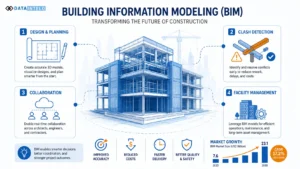
The Difference between BIM and Traditional CAD
In traditional CAD systems, two-dimensional drawings were made a floor plan here, an elevation there, each drawing done independently and sometimes out of sync with the other drawings. In BIM, however, things are done differently. Rather than making drawings, users create an intelligent model in which:
- All elements include data walls aren’t just lines, but rather objects that include details about materials, fire rating, and costs.
- Several disciplines collaborate on the same model rather than architects, structural engineers, and MEP teams creating independent drawings, each discipline works within the same coordinated database.
- Errors are identified early if ductwork is to be placed straight through a structural beam, the clash is automatically detected before construction begins, not during the construction process.
- The model continues to function long after the project has been handed over to its owners, becoming the basis for facility management and maintenance scheduling and even renovations down the road.
That last feature has been driving the adoption of BIM technology faster than ever.
Recent Developments Driving the BIM Boom
A few trends have pushed BIM from “nice to have” to “hard to avoid” over the past couple of years:
Cloud Collaboration Became the Norm
Today, remote and distributed team collaboration has become common place within engineering and construction. BIM applications hosted on the cloud can allow the architect in one city, structural engineer in a different city, and construction team on site access to the live 3D model and work out any discrepancies instantly in hours compared to weeks of back and forth during face-to-face meetings.
Governments Are Mandating It
Regulatory pressure has turned BIM from optional to required on many public projects. The UK’s BIM Level 2 requirements, Singapore’s mandatory BIM submissions for developments above a certain size, and similar rules in Australia have forced entire supply chains — subcontractors included to get comfortable with digital modeling just to stay competitive on bids.
BIM Is Merging With Digital Twins
Amongst the most fascinating changes to occur recently is the way that the information provided through BIM is now not restricted to the end of the project but, instead, is becoming used by facility management at institutions like hospitals, universities, and large corporate real estate portfolios, who are now utilizing design phase BIM models as operational digital twins for the ongoing monitoring of heating/ventilation/air conditioning system efficiency and other metrics. Buildings which are doing this are showing reductions in operating expenses.
Built-in Sustainability & Carbon Reporting
With the tightening of ESG disclosure laws in different parts of the world, the Building Information Modeling software is now including carbon accounting and life cycle analysis within its system. With this, architects are able to see how their choice of materials affects embodied carbon even before any construction begins.
Market Outlook: An Industry on an Even Keel
Numbers speak for themselves, supporting evidence from construction sites. As seen in a Global Market Research Report by Dataintelo on Building Information Modeling (BIM), the global market size of Building Information Modeling was worth about $10.2 billion in 2025 and is estimated to grow to about $33.8 billion in 2034, reflecting an annual growth rate of 14.2%.
Some of the noteworthy trends on the segment level are as follows:
- Software is winning, but the service space is rapidly catching up. The design and collaboration software segment has a higher market share compared to the consultancy, training, and implementation services space that is growing due to the increasing realization by organizations that implementing BIM involves much more than just licensing the software.
- The construction phase accounts for the most significant use case. Coordination and clash detection at the construction stage constitute the largest market share in BIM spend because this is when it becomes most costly to rectify mistakes.
- The operations and facility management phase is experiencing rapid growth. With many buildings operating in a digital-twin-like manner, BIM use at the post-construction stage is growing rapidly.
- Asia-Pacific is leading in regional market growth driven by urban construction in China, India, and Southeast Asia and the adoption mandate of countries such as Singapore. North America and Europe continue to be major, mature markets but their share is expected to shrink.
Growth Factors Behind BIM’s Rise
A number of factors are driving BIM adoption to remain on an upward trend:
- Concurrent reduction. With 3D models, any possible clashes during the design phase are identified early on to prevent costly mistakes on site later on, and this is perhaps the fastest return companies get from BIM.
- Government impetus. As governments continue to make the use of BIM obligatory in order for businesses to compete for public works, developers and contractors are implementing BIM simply to qualify for such work.
- Pre-fab and offsite construction. The 3D BIM model can be used to control machines in the process of prefabrication and offsite assembly of building components.
- Talent and training development. More universities and organizations are integrating BIM into their education programs for architecture and engineering, making up for the skills gap that was delaying its adoption by small companies.
- Lower cost of entry. Cloud-based subscription licenses for BIM software allow smaller companies to access enterprise-level modeling, which they could not afford with the traditional license fees.
Key Insights for Construction Professionals
For firms weighing how deeply to invest in BIM, a few practical takeaways stand out:
- Start with coordination, expand later. Many organizations see the fastest payback from using BIM purely for clash detection and coordination during construction before expanding into full lifecycle use.
- Training is not optional. The steepest barrier to BIM adoption isn’t the software cost — it’s building internal capability. Efficiency gains promised by firms often fail to materialise because of insufficient investment in training.
- Look beyond handover. Building owners who request BIM-ready models upon project completion are setting themselves up to save a great deal of money in the long-term in maintenance and space planning, even if that value isn’t apparent during construction.
- Interoperability is important. There are many software vendors, so companies should look at open standards such as Industry Foundation Classes (IFC) to avoid being locked into one platform’s ecosystem.
Final Thoughts
BIM technology has far surpassed the stage where it was an experiment. It has become a normal, routine part of the processes of designing, constructing, and managing contemporary buildings, and market research shows there is plenty of room for further development. The task for all those involved in construction, from architects and engineers to contractors and building owners, is not whether to use BIM technology, but how fast and how extensively.
Read A Full Report: https://dataintelo.com/report/global-building-information-modelling-market