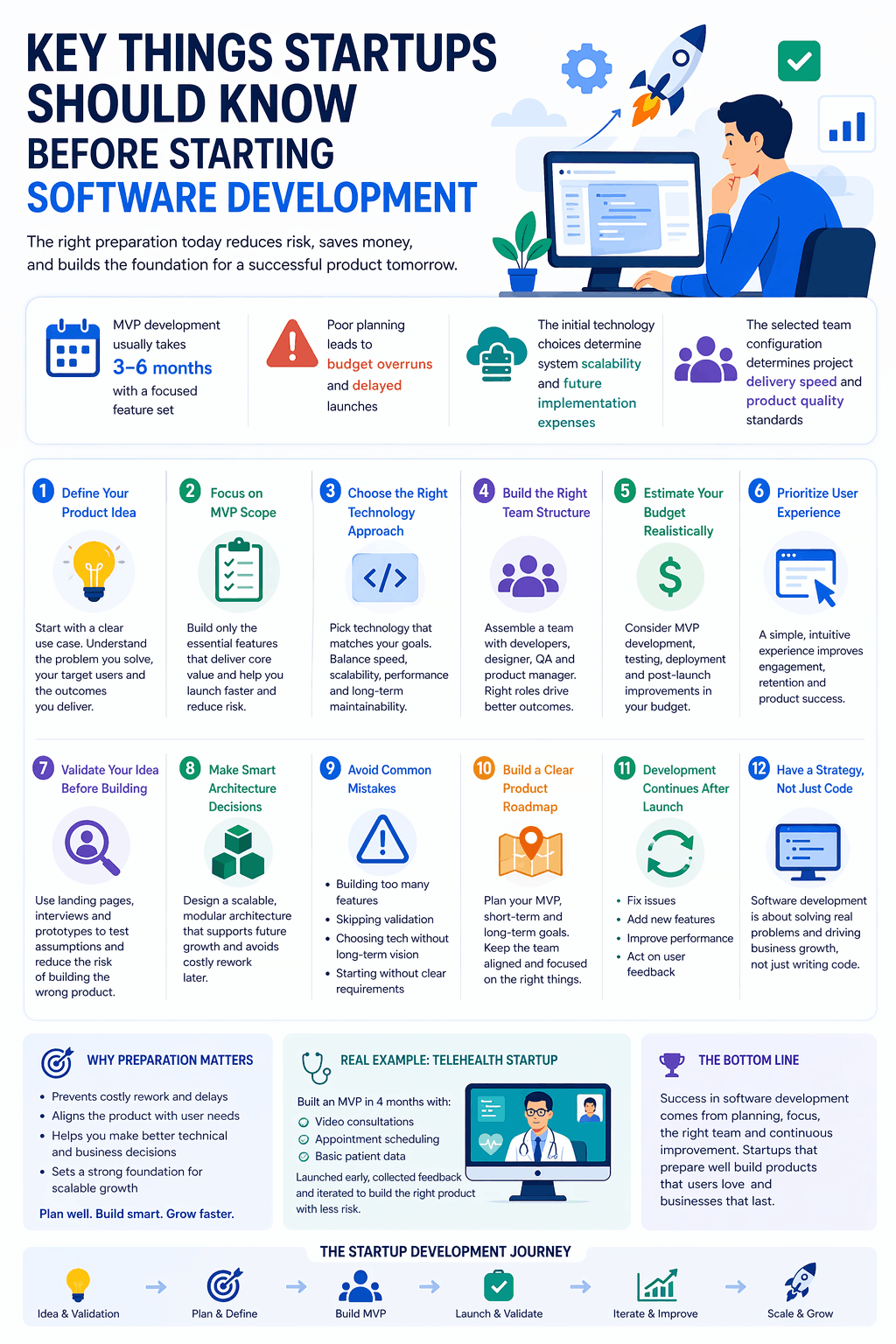
- MVP development usually takes 3–6 months with a focused feature set
- Poor planning leads to budget overruns and delayed launches
- The initial technology choices made during the project determine both system scalability and future implementation expenses
- The selected team configuration establishes both project delivery speed and product development standards which need to be achieved.
Many startups begin software development with a strong idea but limited technical clarity. The situation results in three consequences which include missed deadlines and increased costs and the need for product rework.
Founders collaborate with software development company for startups to define project boundaries and test business concepts and develop solutions which can grow from their initial launch. The approach establishes organization to a process which tends to develop into disarray.
Why preparation matters before writing code
Many founders think development starts with coding. The actual process of development begins after the team makes their initial decisions.
Teams create features without proper needs assessment because they lack essential requirements. Development becomes more expensive and time-consuming to complete because every alteration adds extra work to the process.
The process of preparation establishes three critical aspects of product development. The product requirements determine which functions the system will deliver. The target audience needs identification defines the user group for the product. The system needs assessment defines the required capacity for future growth.
Startups that dedicate their time to planning activities will experience lower risks while they will accelerate their progress after their development work starts.
How to clearly define your product idea
The development process becomes confusing when a project lacks defined objectives. Every decision should follow from the defined project objectives. The project needs a specific use case to establish its product description. A person who works from home needs a product that delivers short exercise sessions to stay active during their job.
The team uses this understanding to:
- Create a list of important features
- Develop pathways for user interaction
- Bring team members to a shared understanding
The development process becomes completely unstructured when development teams start making incorrect assumptions about project requirements.
Why MVP scope determines your launch speed
Startups frequently attempt to create excessive products during their initial stages which results in development delays and higher project dangers.
The main goal of an MVP is to present essential system functions which deliver primary benefits to users without any extra functionalities:
- A complete MVP definition should contain these components
- The main user path
- The necessary system functions
- The system needs to provide an easy-to-use interface
A marketplace minimum viable product requires basic user registration and listing functions and fundamental transaction capabilities but does not need advanced data analysis methods or complex product recommendation systems.
The system enables organizations to introduce their products quickly while testing their business models at an early stage.
How to choose the right technology approach
The process of selecting technology solutions affects two factors which are operational speed and future growth potential. Startups usually choose between cross-platform and native development. Cross-platform development enables quicker product delivery while reaching a wider customer base.
Native development fits products with high performance requirements. The main challenge exists in preventing excessive development work. A simple scalable architecture system enables developers to create products more quickly while decreasing future expenses.
Early development of complex systems leads to unnecessary project delays.
Why the right team structure matters
The process of product development requires human involvement to create products which use technological solutions. Startups require a team who can handle all phases of product development. The standard configuration contains Developers who work on both backend and frontend systems.
The team requires a UI/UX designer who will create user interfaces and user experiences. The team needs a QA engineer to test software applications. The team needs a product manager to oversee development work. The solution for each problem exists in a different role.
User experience quality decreases when systems lack appropriate design. The software release process experiences delays because bugs remain untested without quality assurance.
Startups which depend on uncoordinated teams face difficulties because team members struggle to share information. The use of organized teams leads to better team interactions which result in faster work completion.
How to estimate your budget realistically
Budget planning requires a clear understanding of scope.
The costs of a project depend on three factors which are feature complexity and development timeline and team size and expertise.
Many startups underestimate costs and run out of resources before launch.
A realistic budget includes:
- MVP development
- testing and deployment
- post-launch improvements.
The planning of these stages protects project continuity by preventing any work interruptions.
Why user experience should not be delayed
The way users experience your product determines their interaction patterns. The users of your product will experience confusion and decreased engagement because of its poor user experience design. The product will succeed only when users can navigate its technical features without difficulty.
Good UX design needs to provide users with:
- assistance through their navigation path
- design elements that create a coherent experience
- system components which respond to user input without delay
Users expect intuitive interfaces. Users will abandon the product when they find its controls complex.
The company will achieve better user retention and conversion rates when it invests in user experience design during the early stages.
Common mistakes startups should avoid
Startups encounter similar obstacles which persist throughout their entire development process. The most common mistakes include:
- Trying to build too many features at once
- Skipping validation and relying on assumptions
- Choosing technology without long-term vision
- Starting development without clear requirements.
The mistakes create more dangerous situations while they decrease operational effectiveness. The process of avoiding these mistakes demands practitioners to exercise self-control while they concentrate on their essential tasks.
How to validate your idea before development
The process of validation helps to determine if your product successfully addresses a genuine issue. Startups can validate their business assumptions by conducting tests which require less than complete product development.
The following activities can be included in the project scope. The first task requires the team to develop a landing page which should present its value proposition in a clear manner. The second task involves conducting user interviews. The third task requires testing of interactive prototypes.
The process of validation delivers feedback which helps inform decisions before development work begins. The process helps to decrease potential threats while supporting the development of feature priorities.
How architecture decisions affect future growth
The development of your product needs architectural design. Architectural design flaws result in performance problems which restrict system scalability. The solution requires extensive work to correct these issues.
A modular system design enables better expansion capabilities. The system allows teams to develop new features while keeping existing features operational.
Startups should plan their architectural systems to support their future business development needs.
The approach establishes permanent security for the system.
Real example of startup development strategy
The startup intended to develop a telehealth platform which would include advanced features. The team chose to develop their project through the creation of a basic minimum viable product instead of building all features at once.
The initial product version contained:
- Video consultations
- Appointment scheduling
- Basic patient data
The product developed through four months of work.
The team collected user feedback after the product launch and used it to develop new features in their product. The method decreased risk while it helped achieve better product-market alignment.
Why development continues after launch
The process of launching a product leads to ongoing work. The post-launch development phase includes three main tasks. The team needs to solve existing problems. The team needs to implement new capabilities.
The team needs to enhance system efficiency. The process depends on user feedback as its main element. Startups that maintain ongoing product development will keep their position in the market.
How to build a clear product roadmap
The roadmap defines the future development path of your product. The project requires three main components for its completion, which are the minimum viable product launch and the upcoming short-term enhancements and the upcoming long-term product development.
The established framework enables better task management while resource distribution is controlled. The established roadmap system maintains team direction while they work towards achieving organizational objectives.
Final thoughts
Startups achieve success when they implement their software development work through a planned and deliberate method. The combination of proper planning with achievable goals and appropriate team selection enables organizations to decrease risks while achieving better results.
Development work needs proper preparation because its absence creates problems that result in cost increases and delays. Startups use a structured framework to accelerate their product development process which leads to the creation of products that provide genuine benefits.
Software development involves more than code writing because it requires building a product that offers solutions to existing problems while enabling business growth.